Europe as the Promised Land
Three Bags FullEurope as the Promised Land is the future George Glenn promised his sheep and secured through his will. For the flock, Europe begins less as a known place than as a vivid prospect of abundance; legally, it depends on money, an authorized human representative, and safeguards for the animals. The promise gives direction to the flock after George Glenn’s death, but its fulfillment also requires leaving the pasture they know.
A promise set against the pasture
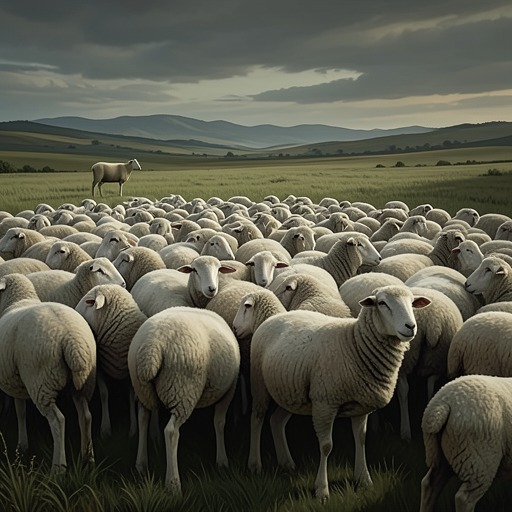
The promise takes shape against a landscape where the sheep’s life has depended on George Glenn’s presence. After finding him dead beside the hay barn, they face a world without their shepherd. His death also leaves the flock exposed to competing human interests. Josh and Tom O’Malley discuss the land as a potential source of profit and fear that the discovery of drugs could damage plans for tourism and development. Their view of the pasture as a commercial asset sharply contrasts with the future George Glenn had promised his sheep: they are not merely to remain on land that other people covet, but to travel to Europe.
The flock’s experience of human use is not limited to ownership and development. When Gabriel takes up George Glenn’s scythe and cuts grass for his sheep, the animals see a human grazing in a way that destroys grass without eating it. The scene makes the flock’s dependence on human decisions tangible: their food, safety, and movement can be shaped by people whose purposes they do not share. Against that uncertainty, Europe signifies a different arrangement, one in which the sheep’s continued care is written into a legal plan.
The promise becomes a legal arrangement
At the reading of the will, the lawyer announces that George Glenn leaves his remaining fortune to the sheep so they can go to Europe as he promised. The amount is substantial enough to astonish the listeners, although the sheep do not understand the number. The inheritance turns a promise into a practical possibility, while the lawyer’s role makes clear that the money will be administered rather than handed over to the animals themselves.
Travel also requires an authorized representative to accompany the flock as its shepherd. The will specifies that this person will have defined rights and duties, and the lawyer is to appoint the representative, preferably at once. The conditions are unusually specific: the sheep are not to be sold or slaughtered, dense fleece is to be the principal concern in breeding, and stories must be read aloud to them for at least half an hour each day. The lawyer will check compliance as a third party. The representative receives a salary, but it decreases whenever a sheep dies. Europe is therefore not simply a destination bought with George Glenn’s money; it is a regulated arrangement intended to preserve the flock and attend to its needs.
Choosing a shepherd
The prospect of the appointment draws the villagers’ attention to Gabriel, who stands beside the lawyer. Their silence, despite their evident interest in the opportunity, resembles the flock’s deference to a lead ram: no one challenges someone who appears already to have taken charge. The lawyer asks whether anyone else wants the job. Rebecca then volunteers, offering a voice suited to reading aloud and a possibility the sheep can accept.
The flock’s choice is not made for them by the will or the lawyer. Othello steps forward, looks at Gabriel, and calmly goes to Rebecca; the other sheep follow until they cluster around her. Gabriel’s soft Gaelic murmuring does not draw them back. Their response becomes unanimous, and the lawyer closes his briefcase and wishes George Glenn’s sheep well in Europe. The scene gives the legal process its necessary representative, but also shows the animals acting collectively to decide who will lead them. For the sheep, Gabriel is not a reassuring route to the promised destination; with Rebecca, they can imagine going there safely.
What Europe means to the flock
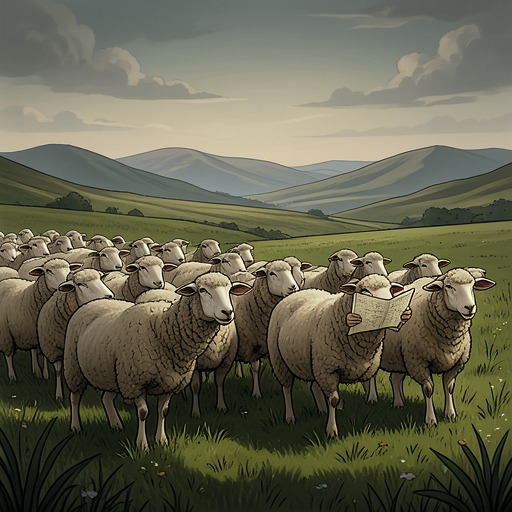
The sheep receive the news first as a destination and then fill it with what they can picture. They imagine a huge meadow full of apple trees, and Mopple the Whale compares the news to the simultaneous arrival of favorite foods; Lane adds calcium tablets to the vision. Their joy comes gradually but intensely. Heather leaps, the lambs celebrate, Zora retreats to meditate, and Sir Ritchfield quietly hums. The different responses register the scale of the promise without requiring the sheep to share a single way of expressing happiness.
For Othello, Europe also gives purpose to skills learned from George Glenn. In the evenings behind George Glenn’s shepherd’s caravan, George taught him how to lead a flock, keep his nerve while moving, and guide others cautiously past or over obstacles. Othello had expected those lessons to matter on the journey. George Glenn will not go with them, but Othello sees Rebecca as a leader worth following. The promised trip thus carries George Glenn’s teaching forward even in his absence.
Departure and the cost of leaving
Rebecca’s reading aloud gives the promise a more intimate, painful echo. In a story about a girl with a secret father, the father plans to travel to Europe and first wants to see her; the girl hides her joy and keeps him waiting until he dies. The story recalls the rupture between Rebecca and George Glenn and links Europe not only to a future journey but also to a meeting that came too late. The flock hears the story as a sad tale, while its personal significance rests in what it reflects about Rebecca’s loss.
As the departure approaches, Rebecca tells the sheep they are leaving very early the next day. The flock celebrates the immediacy of the journey, but Cordelia points out that going to Europe means leaving here. The others agree. Mopple imagines the impossible compromise of grazing in both places at once. That wish holds the tension at the heart of the promise: Europe offers food, care, and a future arranged beyond George Glenn’s pasture, yet the pasture remains home. The supplied ending leaves the sheep poised to depart, their excitement intact and their attachment to the place they must leave newly spoken aloud.